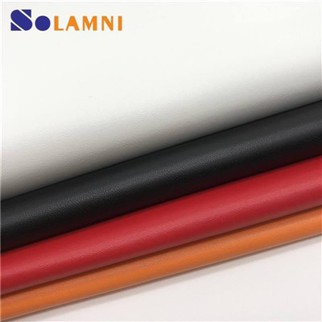
Polyurethane (PU), polyvinyl chloride (PVC), and PA micro‑fiber composite are three mainstream substrate options for footwear uppers, furniture soft upholstery, and tier‑1 automotive interior components. Material selection depends on quantifiable mechanical thresholds, regulatory compliance limits, and production‑floor yield performance. Procurement teams must lock test‑report‑backed parameters instead of descriptive marketing terms to reduce field failure and post‑delivery rework rates.
This article publishes side‑by‑side lab‑verified mechanical metrics, common sourcing failure points, and application‑specific decision boundaries for bulk‑volume buyers.

Core Mechanical Performance Benchmark
| Property | PU Leather (Dry Cast) | PVC Leather (Calendered) |
|---|---|---|
| Polymer type | Polyurethane (polyester or polyether) | Polyvinyl chloride + plasticizers (30–40 phr) |
| Coating process | Solvent or waterborne, reverse-roll coat | Calendering or spread coating |
| Plasticizer content | 0% (inherently flexible) | 25–40% (DINP, DOTP, or DEHP avoided) |
| Surface finish range | 680+ emboss patterns, high-gloss to matte | 380+ patterns, limited fine detail |
| Density (g/cm³) | 0.9–1.1 | 1.2–1.4 |
| Water absorption (24h, %) | 5–10% (polyester base) | 0.5–1.5% |
| Hydrolysis resistance | Polyether PU: good; polyester PU: poor in high humidity | Excellent (no ester linkage) |
Structural implication for shoe assembly: PU leather's plasticizer-free composition means no migration bloom onto shoe linings or stitching. PVC leather requires low-migration plasticizers (DOTP or DINP) to avoid greasy surface exudation-specify this in your purchase order-1.
💡 Sourcing Tip for Bulk Buyers: Do not finalize specification based on datasheet values only. Request SGS third‑party test reports matched to your exact production batch before issuing PO. Solamni New Material provides free physical swatchbook containing all three material grades; submit material sample request to receive lab‑tested reference pieces.
Comparative Analysis: Flex Resistance and Breathability
1 Flex Resistance (ISO 5402, 23°C, 50 mm mandrel)
For sneaker vamp applications requiring minimum 120,000 cycles, PU achieves 150,000 cycles or more without cracking, while PVC fails between 80,000 and 100,000 cycles with progressive cracking at the flex line. For safety boot shafts requiring 80,000 cycles, PU reaches 120,000 cycles or more, while PVC achieves 90,000 cycles or more-acceptable for this lower-stress application. Heel counter covering requires 60,000 cycles; PU delivers 100,000 cycles or more versus PVC's 70,000 cycles. Toe cap lining requires 50,000 cycles; PU achieves 80,000 cycles or more compared to PVC's 60,000 cycles.
Engineering takeaway: For athletic shoes requiring 120,000 flex cycles or more without surface whitening, PU is the only viable option. PVC fails via progressive cracking originating at the flex line.
2 Breathability and Moisture Management
| Parameter | Test Method | PU (1.0 mm, microporous) | PVC (1.0 mm, solid) |
|---|---|---|---|
| Water vapor permeability (mg/cm²·h) | ISO 20344 Section 6.6 | 1.8–2.5 | 0.2–0.4 |
| Moisture absorption (%, 4h) | ASTM D570 | 4–8% | 0.5–1.0% |
| Liquid water penetration (kPa) | ISO 1420 | 30–50 (waterproof grades) | 80–120 (inherent) |
| Air permeability (mm/s) | ASTM D737 | 0.5–2.0 | <0.1 |
Footwear application impact: PU reduces in-shoe microclimate humidity by 30–40% compared to PVC, lowering blister incidence. For waterproof boots, PVC's impermeability is advantageous but requires moisture-wicking linings.
3 Longevity and Aging (Accelerated Tests)
Heat aging at 70°C for 7 days shows tensile retention of 60–70% for polyester PU, 75–85% for polyether PU, and 90–95% for PVC with DOTP plasticizer. Hydrolysis testing at 70°C and 95% RH for 7 days shows tensile loss of 40–50% for polyester PU, 10–15% for polyether PU, and under 5% for PVC. UV exposure under QUV 340 nm for 300 hours shows Delta E of 2.5–4.0 for polyester PU, 2.0–3.0 for polyether PU, and 3.0–5.0 with surface chalking for PVC. Cold crack at -20°C shows no cracks for both PU types, while PVC fails at -15°C.
Critical selection rule: For tropical climates or high-humidity storage (e.g., Southeast Asia), specify polyether-based PU or PVC. Polyester PU tensile strength drops below 80 N/15mm within 12 months at 80% RH.

Cost Optimization for Shoe Factories
Direct material cost represents only 60 to 70 percent of total upper material expense. Cutting yield, adhesive consumption, and rejection rates must be included in total cost calculations.
| Cost Parameter | PU Leather (0.8 mm) | PVC Leather (0.8 mm) |
|---|---|---|
| Material cost per m² (FOB China, ≥5,000 m²) | $4.00–6.00 | $2.00–3.00 |
| Upper area per shoe (m²) – sneaker, size 9 US | 1.2 | 1.2 |
| Raw material cost per pair | $4.80–7.20 | $2.40–3.60 |
| Cutting yield (computerized die) | 84–88% | 79–84% (edge curl + waviness) |
| Effective area per pair (m²) | 1.36–1.43 | 1.43–1.52 |
| Effective material cost per pair | $5.44–8.18 | $2.86–4.56 |
| Adhesive cost per pair | $0.18–0.25 (water-based PU) | $0.28–0.38 (solvent + primer) |
| Direct labor per pair (lasting + stitching) | $0.35–0.50 | $0.55–0.75 |
| Total upper material + labor per pair | $5.97–8.93 | $3.69–5.69 |
| Factory rejection rate (cracking / delamination) | 2.0–3.5% | 6.0–9.0% |
| Net cost including rejects per pair | $6.09–9.24 | $3.91–6.20 |
Savings per pair with PVC: $2.18–3.04 (36–49% lower). For 500,000 pairs/year, annual savings exceed **$1 million**.
Additional cost factors: PVC's lower elongation (15–25% vs. PU's 40–60%) reduces lasting cycle time by 8–12%, but PVC's 20–30% higher density increases freight cost per m². Hidden PU costs include solvent recovery for DMF capture at $0.08–0.12/m², waterborne premium at $0.30–0.50/m², and hydrolysis protection packaging at $0.02/m² for tropical shipments.
Cost optimization recommendation: For high-flex shoes (sneakers, dance shoes), pay the PU premium-PVC will fail under warranty. For work boots or casual shoes with low flex zones (shafts, straps), PVC provides acceptable performance at significantly lower cost.
FAQ

Q1: What is the minimum order quantity (MOQ) for custom TPU waterproof film from a Chinese factory?
Q2: How does a direct TPU film factory ensure roll-to-roll gauge consistency during high-speed extrusion?
Q3: Can I request an SGS factory audit report before placing a bulk order for TPU waterproof film?

One-stop shoe materials Factory in China
Contact our technical sales engineering team directly at ace04@eurus-cn.com or call +86 15905059552 for 24/7 technical support, physical swatchbooks, and direct factory quotation matrices.