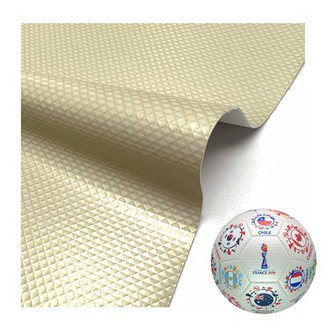
TPU waterproof film is a monolithic, non-porous thermoplastic polyurethane membrane engineered for multi-layer technical shell fabrics, balancing high hydrostatic head resistance ($\ge 10,000\text{ mm H}_2\text{O}$) with solid-state moisture vapor transmission rates (MVTR $\ge 15,000\text{ g/m}^2/24\text{h}$). Operating on a hydrophilic absorption-diffusion-desorption mechanism, this monolithic barrier eliminates pore-clogging vulnerabilities common in traditional microporous films, ensuring zero performance decay from body oil or detergent residues. Applied via PUR hot-melt reactive lamination, it provides outdoor garment OEMs and technical outerwear brands with a durable, wash-stable ($\ge 50$ laundering cycles) waterproof barrier that resists delamination and seam tape breakdown under dynamic stress.

Technical Performance: Microfiber PU vs. Nappa vs. Standard PU
Selecting technical membranes for high-performance outdoor apparel requires balancing waterproof barrier integrity against breathability and structural wash stability. The engineering parameters below define Solamni technical TPU membranes across 2-layer (2L), 2.5-layer (2.5L), and 3-layer (3L) shell laminates:
| Physical & Mechanical Parameter | Technical TPU Monolithic Film | Standard Microporous PTFE Film | International Testing Standard |
| Transport Mechanism | Solid-State Hydrophilic Diffusion | Physical Micro-Pore Capillary Flow | Scanning Electron Microscopy (SEM) |
| Film Gauge Thickness | $12\mu\text{m} - 25\mu\text{m} \pm1.0\mu\text{m}$ | $15\mu\text{m} - 30\mu\text{m}$ | ISO 4593 |
| Hydrostatic Head Pressure | $\ge 10,000 - 20,000\text{ mm H}_2\text{O}$ | $\ge 15,000 - 28,000\text{ mm H}_2\text{O}$ | ISO 811 / AATCC 127 |
| Moisture Vapor Transmission (MVTR) | $\ge 15,000\text{ g/m}^2/24\text{h}$ (Inverted Cup) | $\ge 20,000\text{ g/m}^2/24\text{h}$ | JIS L1099 B-1 / ASTM E96 |
| Wash Durability (Hydrostatic Loss) | $< 5\%$ loss after 50 wash cycles ($40^\circ\text{C}$) | $15\% - 30\%$ loss (pore clogging) | ISO 6330 / AATCC 135 |
| Lamination Peel Strength | $\ge 12\text{ N/2.5cm}$ (PUR Hot-Melt) | $\ge 8\text{ N/2.5cm}$ | ISO 2411 |
| Elongation at Break (MD/CD) | $\ge 450\% / \ge 400\%$ | $< 150\%$ | ASTM D882 |
| Environmental & Chemical Safety | Fluorine-Free (PFC/PFAS-Free), REACH | May contain trace PFAS/PTFE chemistries | Oeko-Tex Standard 100 / REACH |
💡 Sourcing Tip for Bulk Buyers: Engineering next-generation 3-layer Alpine shells or lightweight running jackets? Explore our full lineup of high-performance TPU Film formulations to request technical datasheets, PUR lamination guidelines, and free physical membrane master sample swatches directly from our technical team.
Technical Engineering Drivers for Outdoor Outerwear Applications
1. Microporous vs. Monolithic Membrane Transport Mechanics
Microporous membranes rely on physical air gaps (approx. 0.2 microns) that are smaller than water droplets but larger than vapor molecules. However, environmental contaminants like sebum (skin oil), insect repellents, and detergent surfactants coat these pores, causing hydrophobic failure and water leakage over time. Solamni monolithic TPU membranes operate on a solid-state molecular chain mechanism: hydrophilic polyether segments within the TPU polymer absorb moisture vapor on the high-humidity interior face, diffuse water molecules along the polymer chain, and desorb them into the lower-humidity ambient atmosphere. Because the membrane has zero physical pores, oil contamination cannot compromise waterproof performance.
2. Balancing Moisture Vapor Transmission Rates (MVTR) with Hydrostatic Head
In technical outerwear, increasing film thickness improves water column resistance (hydrostatic head) but increases vapor diffusion resistance, reducing overall breathability. Solamni engineers precise molecular block-copolymer ratios, combining hard polyisocyanate segments for tensile strength with soft polyether blocks for moisture transfer. This molecular architecture allows thin $15\mu\text{m}$ membranes to sustain water column pressure exceeding $15,000\text{ mm H}_2\text{O}$ while maintaining high inverted-cup MVTR figures ($\ge 15,000\text{ g/m}^2/24\text{h}$ per JIS L1099 B-1), preventing interior condensation buildup during active exertion.
3. Wash Durability and Delamination Prevention under Repeated Laundering
Repeated machine laundering subjects laminated fabrics to severe hydraulic shear forces and thermal expansion stresses, often leading to membrane blistering, edge peeling, or delamination. Solamni TPU membranes are modified with reactive cross-linking agents that bond chemically with Polyurethane Reactive (PUR) hot-melt adhesives. During flat-bed or engraved-roller lamination, PUR adhesive forms covalent cross-links with both the TPU membrane and face/lining fabrics, achieving peel strengths $\ge 12\text{ N/2.5cm}$ that easily survive 50 standard commercial laundry cycles at $40^\circ\text{C}$ without delamination or hydrostatic degradation.
4. Lamination Parameters for Multi-Layer Technical Shell Fabrics
Achieving defect-free 2.5L and 3L shell fabric performance requires precise thermal and pressure management during roll-to-roll PUR lamination:
- Temperature Profile: Maintain gravimetric roller temperature between $110^\circ\text{C}$ and $125^\circ\text{C}$ to melt the PUR adhesive without exceeding the TPU film soft-point ($140^\circ\text{C}$).
- Adhesive Coverage & Engraving Mesh: Apply 3-point or 4-point micro-dot gravure patterns yielding $5\text{ g/m}^2$ to $8\text{ g/m}^2$ adhesive density. Over-application reduces breathable surface area, while under-application causes delamination.
- Nip Pressure & Line Speed: Enforce a nip roll pressure of $2.5 - 3.5\text{ bar}$ at line speeds between $15 - 25\text{ meters/minute}$ to ensure uniform adhesive wetting without crushing the membrane's elastic recovery structure.

Solamni Laboratory Quality Control & Testing Standards
To ensure consistent waterproof and breathable performance across large-volume container shipments, Solamni tests every lot of TPU membrane within our SGS-verified testing facility:
- Hydrostatic Head Testing (ISO 811): Film samples are subjected to a continuous water pressure rise rate of $60\text{ cm H}_2\text{O/min}$ until three water droplets penetrate the surface, verifying compliance against client minimum pressure targets.
- Dynamic Inverted-Cup MVTR (JIS L1099 B-1): Membrane laminates undergo potassium acetate inverted-cup testing under constant climate control ($30^\circ\text{C}$, 80% RH gradient) to measure exact 24-hour vapor transmission capacity.
- Tensile & Elastic Recovery (ASTM D882): Film specimens are stretched to 100% elongation and released to measure tensile modulus and elastic recovery rates, ensuring the film stretches with high-gauge 4-way stretch outer shell fabrics without pinhole tearing.
- PFC/PFAS Chemical Screening: Every production run is tested via GC-MS and LC-MS to guarantee 100% fluorine-free compliance, satisfying strict European OEKO-TEX Standard 100 Annex 6 and REACH SVHC regulations.
🛠️ Factory Assistance for Technical Apparel Developers: Need custom membrane thickness, tailored MVTR-to-hydrostatic ratios, or specific lamination parameters for light 15D nylon shell fabrics? Our technical engineering team provides fluent English support, customized lab-laminated hand-sheets, and full test data sheets within 5 to 7 working days. Contact Sales Engineering to request your free master membrane sample kit today.
FAQ

Q1: What is Solamni's standard Minimum Order Quantity (MOQ) and production turnaround for custom TPU breathable membranes?
Q2: How does Solamni TPU membrane handle seam sealing tape application on garment assembly lines?
Q3: Are Solamni TPU breathable membranes fully compliant with PFC-free environmental standards?

One-stop shoe materials Factory in China
Contact our technical sales engineering team directly at ace01@eurus-cn.com or call +86 13459576329 for 24/7 technical support, physical swatchbooks, and direct factory quotation matrices.