

The density of ball leather is a crucial physical property that significantly impacts the performance, quality, and durability of balls used in various sports. As a dedicated ball leather supplier, understanding and controlling this characteristic is fundamental to providing our customers with top - notch products. In this blog, we'll delve into the concept of ball leather density, its influencing factors, and its importance in the sports equipment industry.
Understanding Density
Density is defined as the mass per unit volume of a substance. In the context of ball leather, it represents how much mass of leather is packed into a given volume. The formula for density is $\rho=\frac{m}{V}$, where $\rho$ is the density, $m$ is the mass, and $V$ is the volume. For ball leather, density is typically measured in grams per cubic centimeter ($g/cm^{3}$) or kilograms per cubic meter ($kg/m^{3}$).
The density of ball leather can vary widely depending on the type of leather, its manufacturing process, and the intended use of the ball. Different sports balls, such as footballs, basketballs, and volleyballs, require specific density ranges to meet the performance standards of their respective sports.
Types of Ball Leather and Their Density
There are several types of ball leather commonly used in the industry, each with its own characteristic density.
Natural Leather
Natural leather, such as full - grain leather or top - grain leather, is highly prized for its durability, feel, and appearance. Full - grain leather, which is the highest quality and most expensive type, has a relatively high density due to its thick and compact structure. It can have a density ranging from approximately $0.9 g/cm^{3}$ to $1.1 g/cm^{3}$. This high density contributes to its strength and long - lasting nature, making it suitable for high - end sports balls.
Top - grain leather, which is also of good quality but has a thinner surface layer, has a slightly lower density, usually in the range of $0.8 g/cm^{3}$ to $0.95 g/cm^{3}$. It offers a good balance between durability and flexibility, making it a popular choice for many sports balls.
Synthetic Leather
Synthetic leather, including PU (polyurethane) and PVC (polyvinyl chloride) leather, has become increasingly popular in recent years due to its lower cost, ease of production, and customizable properties.
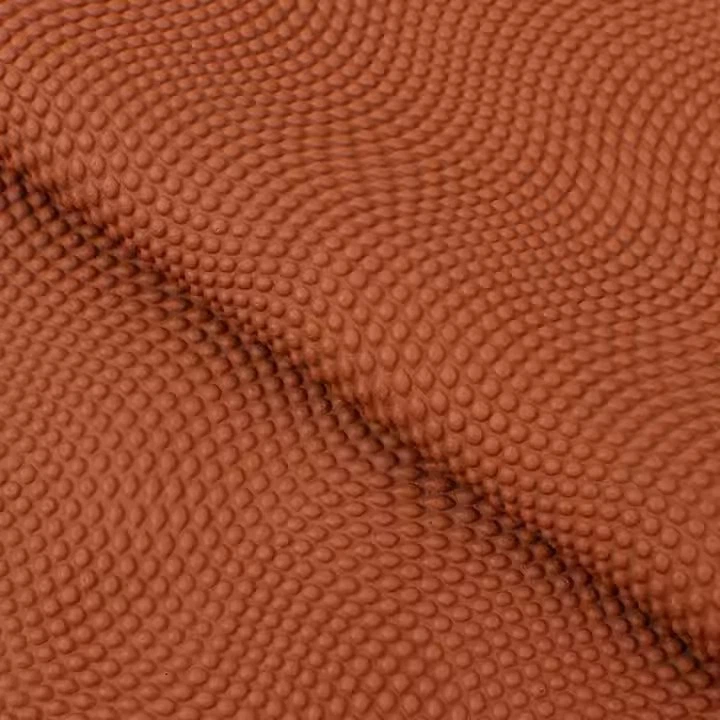
PU leather for balls can have a density that varies depending on its formulation and manufacturing process. Generally, the density of PU ball leather ranges from $0.6 g/cm^{3}$ to $0.8 g/cm^{3}$. This relatively lower density makes it lighter and more flexible, which can enhance the ball's bounce and handling characteristics. You can find our high - quality [Manufacturer Anti - Slip Customized 3D Quality Roll Materials Leather PU For Football](/pu - leather/ball - leather/manufacturer - anti - slip - customized - 3d - quality.html).
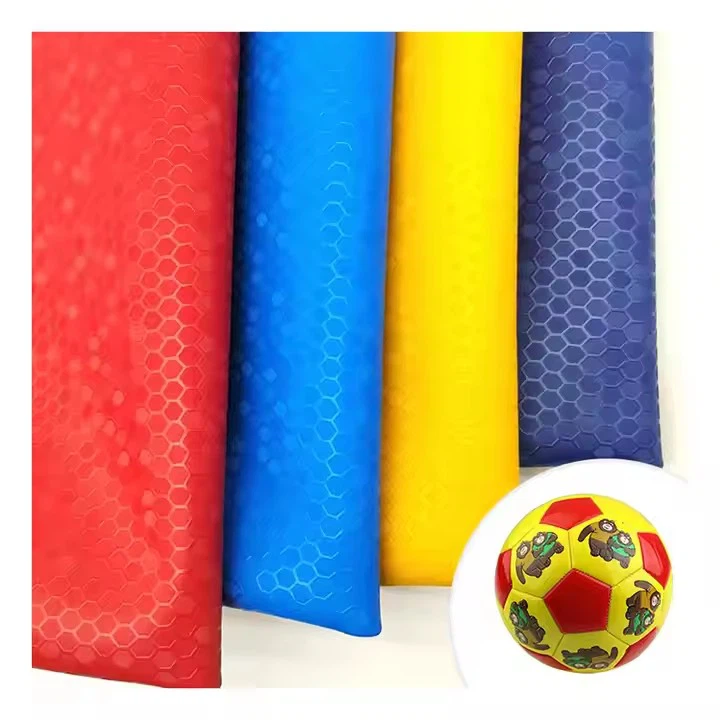
PVC leather, on the other hand, is often more rigid and has a higher density compared to PU leather. The density of PVC ball leather typically falls in the range of $1.1 g/cm^{3}$ to $1.3 g/cm^{3}$. PVC leather is known for its waterproof properties and is commonly used in balls that need to withstand wet conditions. Our [Wholesale 1.5 MM Polka Dot Pattern Waterproof Roll Synthetic PVC Leather Materials For Balls](/pu - leather/ball - leather/wholesale - 1 - 5 - mm - polka - dot - pattern - waterproof.html) is a great example of high - quality PVC ball leather.
Factors Influencing Ball Leather Density
Several factors can influence the density of ball leather:
Material Composition
The type of raw materials used in the leather production has a significant impact on density. As mentioned earlier, natural leather is generally denser than synthetic leather due to its fibrous structure. The addition of fillers, coatings, or additives during the manufacturing process can also affect the density. For example, some synthetic leathers may be formulated with lightweight foams to reduce density and improve flexibility.
Manufacturing Process
The manufacturing process, including tanning, embossing, and finishing, can alter the density of the leather. Tanning, which is the process of treating animal hides to make them more durable, can cause the leather to shrink and become more compact, increasing its density. Embossing, on the other hand, can create surface patterns that may slightly change the volume of the leather without significantly affecting its mass, thus influencing the density.
Thickness
The thickness of the leather is directly related to its density. Thicker leather generally has a higher density because there is more mass in a given area. However, it's important to note that thickness alone does not determine density, as the material composition and manufacturing process also play crucial roles.
Importance of Ball Leather Density in Sports
The density of ball leather is not just a technical specification; it has a direct impact on the performance of sports balls:
Bounce
The density of the leather affects the ball's bounce. A ball with a higher - density leather may have a lower bounce because more energy is absorbed by the leather during impact. On the other hand, a ball with a lower - density leather can have a higher bounce, making it more suitable for sports where a high - bouncing ball is desired, such as basketball.
Handling
The density also influences how the ball feels in the hands of players. A ball with a denser leather may feel heavier and more substantial, which can be beneficial for sports that require a strong grip, such as rugby. In contrast, a lighter - density ball is easier to handle and maneuver, making it ideal for sports like volleyball.
Durability
Density is closely related to the durability of the ball leather. Higher - density leather is generally more resistant to wear and tear, making it suitable for sports that involve rough play or frequent contact with hard surfaces. Lower - density leather, while more flexible and lightweight, may be less durable and require more frequent replacement.
Our Product Range and Density Considerations
As a ball leather supplier, we offer a wide range of products to meet the diverse needs of our customers. Our [Wholesale Custom Basketball Pattern Suede Fabric Stretch Wicking Vinyl PU PVC Synthetic Leather Gloves For Garments Bags](/pu - leather/ball - leather/wholesale - custom - basketball - pattern - suede.html) is designed with the right density to provide optimal performance.
We carefully select the materials and manufacturing processes to ensure that our ball leather products have the appropriate density for their intended use. Whether you need a high - density leather for a durable football or a low - density leather for a lightweight volleyball, we can provide you with the perfect solution.
Conclusion
The density of ball leather is a complex but essential property that affects the performance, quality, and durability of sports balls. As a ball leather supplier, we are committed to understanding and controlling this characteristic to provide our customers with the best possible products.
If you are in the market for high - quality ball leather, we invite you to contact us for a detailed discussion. Our team of experts is ready to assist you in finding the perfect ball leather solution for your specific needs. Whether you are a sports equipment manufacturer, a distributor, or an individual looking for the best ball leather, we look forward to working with you.
References
- ASTM International. (Year). Standard test methods for density and specific gravity (relative density) of plastics by displacement. ASTM D792.
- Smith, J. (Year). The science of sports equipment. Publisher.


